

Conflict of interests
Conflict of interest is a contradiction between an individual’s private interest and their official powers, the presence of which affects (real conflict of interest) or may affect (potential conflict of interest) the objectivity and impartiality of decision-making, and/or the performance or non-performance of actions while exercising their official powers.
In simple terms, a conflict of interest arises when a person finds themselves in a situation where their personal interests may prevent them from making an honest and objective decision. In the case of a potential conflict of interest, the situation may affect the objectivity and impartiality of decision-making, or the performance or non-performance of certain actions while performing official duties.
When does a conflict of interest arise?
A conflict of interest arises in situations where the following three components are present simultaneously:
- Private interest.
- Official powers, during the exercise of which the person can, at their discretion, take actions, make decisions specifically on an issue in which they have a private interest.
- Discretionary nature of official powers.
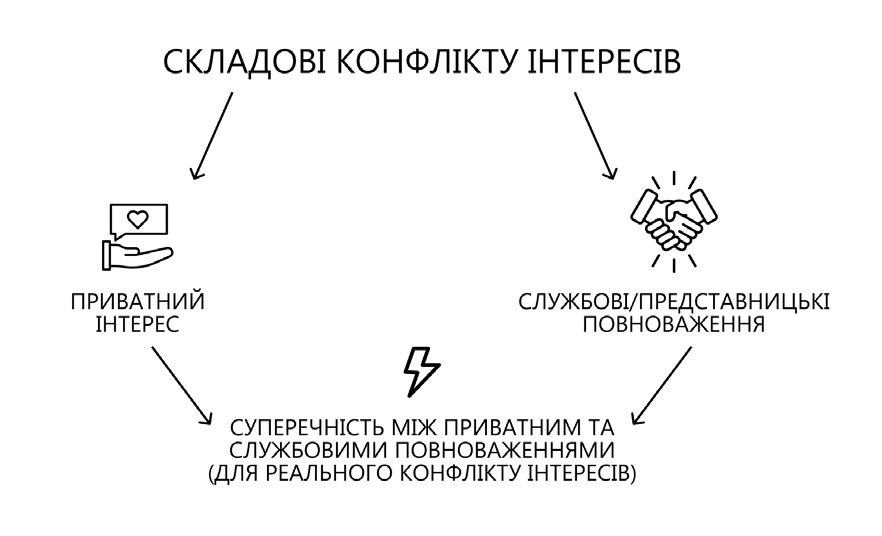
If at least one of the above components is absent in a situation – there are no official powers of a discretionary nature and/or private interest – a conflict of interest does not arise. In practice, difficulties may arise in determining private interest, as well as whether certain powers are discretionary.
Ukrainian legislation does not provide a complete and exhaustive list of circumstances that may constitute a private interest. It is important to remember that personal interest is not always and not only about finances or property – often, private interest can also include intangible things or services. In each specific case, it is necessary to assess all circumstances and relationships that may affect the objectivity and impartiality of our network’s personnel, as well as the specific powers they have.
Private interest is any property or non-property interest of a person, including those caused by personal, family, friendly or other non-official relationships with natural or legal persons, including those arising in connection with membership or activities in public, political, religious or other organizations. Law of Ukraine dated 14.10.2014 No. 1700-VII “On Prevention of Corruption”.
Examples of circumstances/situations related to private interest:
- Family and kinship relationships: when a person works together with relatives or family members, this can influence their decisions. The desire to help loved ones is natural, but it can create a situation where personal interests become more important than professional duties.
- Exercising official powers concerning oneself: if a person makes decisions that directly affect them (for example, setting their own salary), this creates a private interest.
- Receiving a gift: if a person receives a gift, they may feel a desire to reciprocate the giver. This can affect their subsequent decisions or actions regarding that person.
- Concurrent employment: if a person combines work in an organization with entrepreneurial activity, other work, or membership in other organizations, their personal interests may affect their official duties.
- Contractual relationships: in situations where a person has contractual relationships with someone about whom they must make official decisions (for example, a lease agreement with a beneficiary), a desire to maintain favorable terms of these relationships may arise.
- Official relationships/activities: a private interest may arise from a conflict with subordinates or a negative attitude towards a colleague.
- Direct subordination relationships: subordinates may make decisions in favor of a supervisor, hoping for their favor. In turn, the supervisor may seek to “repay” for actions that satisfy their private interest.
“Caritas Ukraine recognizes that a conflict of interest may arise, among other things, in cases where a Staff member:
- receives or may receive personal benefit in substitution for, contrary to, or in addition to income and compensation received directly from Caritas Ukraine;
- must simultaneously perform official duties and pursue their personal interests or the interests of another organization they represent;
- may influence the activities of Caritas Ukraine in such a way that it could lead to direct or indirect financial gains for such person, family members/relatives, business partners or third parties, or the provision of inappropriate/improper advantages to third parties to the detriment of Caritas Ukraine.” Policy for the Prevention of Conflicts of Interest, para. 3
If you have doubts about a conflict of interest, take the test:
- Does the person have a private interest in the situation? That is, do they have a desire for a certain decision or action to be in their favor or in the favor of other people and organizations? If there is no private interest, then no conflict of interest arises.
- Does the person have the authority to make decisions or take actions related to their private interest? That is, do they have the relevant official powers to influence a situation where their interest might be involved? If such powers do not exist, then no conflict of interest arises.
- Does the person violate the conditions defined by the Policy for the Prevention of Conflicts of Interest? If there is a violation of the rules regarding conflicts of interest in our network, this indicates the presence of a conflict of interest.
In addition, all employees and volunteers have the opportunity to contact their direct supervisor or the person responsible for implementing the Safeguarding system in the local organization or national office to clarify issues and receive explanations regarding conflicts of interest.
